Showing posts with label 4th grade. Show all posts

Tuesday, March 13, 2012

Self-Portraits Everywhere!

We're buried in self-portraits at school! I feel like SPs are an annual experiment, and I'm always trying to find new media and inspiration for these. I'm working on Lichtenstein self-portraits with 5th grade right now, and 4th graders are doing an identity project with their self-portraits. I'll post those at the end of the month when they're complete. I'm trying to muster up the strength to do a collage SP project with 3rd grade in April (just thinking about carting around all the materials is giving me a headache). And this year's K and 1st grade splatter self-portraits are here
For now, here are a few of this year's 2nd grade self-portraits. As I usually do with 2nd, we discussed van Gogh and viewed a few of his self-portraits. We also talked about impasto and his use of color in all of his work. As with last year's 2nd grade paintings, we used oil pastels and tempera cakes, but this time we just created background textures (impasto style) with lines and dots, sticking with one color scheme for the background: warm, cool, analogous, primary, secondary, or complementary. Last year's 1st and 2nd grade Expressionist self-portraits can be viewed here.


Thursday, March 8, 2012

Printmaking Test

"Inked" plate ready to go...
I've just started a printmaking project with 2nd grade, using foam printing plates from School Specialty. With Spring Break just a day away, our minds are on the beach, so our theme is folk art beach houses. I stayed after a bit today to do a few test prints, and WOW, I'm so excited to share this process with the kids!

I've used markers to ink plates before, but I just got a set of Mr. Sketch watercolor markers. And after all the great things I've read about them, I couldn't wait to try them out. They work beautifully for inking foam plates! The trick is that you have to print on damp paper (NOT wet...see below). It took me a few attempts to figure out exactly how damp the paper should be to yield successful results. (Note: Lay printing plate flat and lay damp paper on top of plate, pressing gently all over without moving the paper.)

Here are a few photos showing my experiments with various degrees of wet/damp paper.

Print #1: On dry paper, just for comparison.

Print #1: I dipped the paper in the sink, let it drip
a bit, laid it on newspaper to soak up a bit of water,
then laid it on the plate. Didn't work so well.

Print #3: I laid dry paper on the inked plate, then
sprayed water on the paper. Again, not so good.
Print #4: Woohoo! Success!! I dipped the paper in
the sink, then pressed it between newspaper until it
no longer dripped. Then I laid the damp paper on
top of the inked plate, pressed gently to transer the
image, and lifted the print.
Note: I just checked the print, and as I've been typing the edges of some colors have bled just a tad. I'm thinking maybe I'll do one more test (tomorrow...time to go home!) with paper that is just a bit more dry. I think I'll bring in a couple of towels tomorrow and see if that helps. I'll add an update after the adjustments are made.

Wednesday, March 7, 2012

Endangered Species

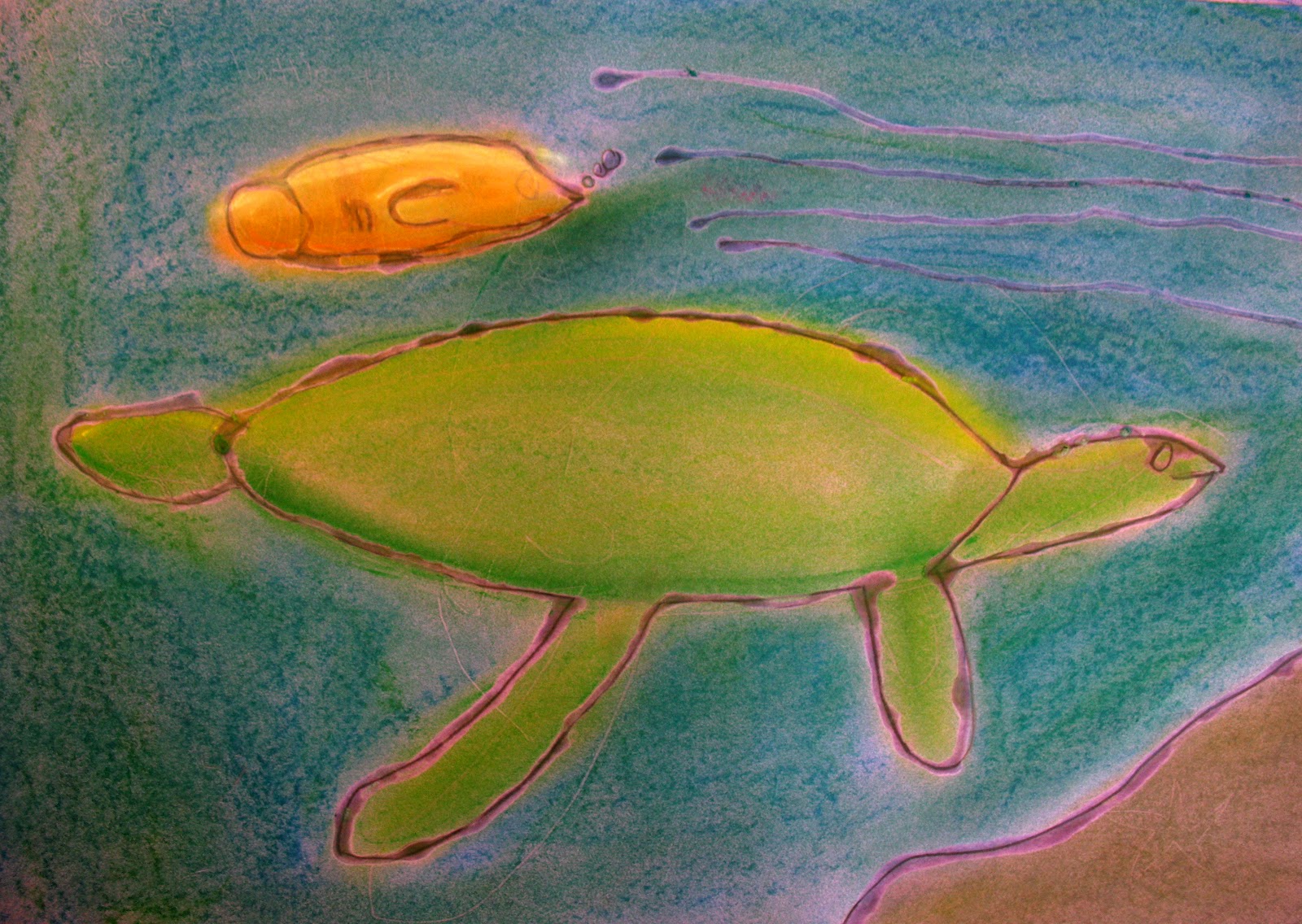
This lesson was inspired by my fellow art teacher last year. I can't remember the web site from which he printed the animal photos (if I find it I'll post the link), but students chose an endangered animal to draw, working from the photos (simple lines, not a lot of detail...we talked a lot about simplifying).

After working out composition, students drew their chosen animal on a sheet of 12x18 colored construction paper. They then traced their lines in glue. The clear, dry glue allowed the construction paper color to show through as the line color. Students then used chalk pastels to add color to their drawing.

Love messy hands!
The big ideas of this project were color and composition. Simplifying the lines of the drawings was an excellent exercise for students, as well, since young artists often get "blocked" when faced with too much detail (where to begin??). So we broke the background information down into basic shapes and spaces. Also, too much detail and the glue lines run together creating puddles, so simplifying was of practical importance, as well. Another benefit was that simplification often led to abstraction, which brought the animal into greater focus.

Here are a few of the finished drawings:


Kandinsky Color Studies

3rd-5th grade artists just completed Kandinsky color studies. We watched a few YouTube videos of his work, and I was amazed at how captivated the students were. There are several, like this one, that simply show a slide show of his work with background music. They're quite calming. I was really amazed by one group of 3rd grade boys who had quite the deep conversation about the shapes, lines, and colors in Kandinsky's paintings, turning their heads to view the works from all angles. Students sketched and doodled in their sketchbooks while watching, making note of elements that they found interesting.

I think every art teacher does this project in some form, but I chose oil pastels and tempera paints for this year. We'd talked about color relationships, and students were given 5 required color schemes that had to be used in their paintings. The 6th square was a free choice square. Any color combo was allowed.

3rd grade colors: Primary, Secondary, Warm, Cool, Complementary (choose one pair), Choice
4th and 5th grade colors: Warm, Cool, Complementary (choose one pair), Analogous, Monochromatic (one color plus white or black)

I did this in four classes:

1. Color Theory Introduction: Students completed a tertiary color wheel using red, yellow, and blue colored pencils. (3rd graders just did primary and secondary colors.)

2. Color Relationships/Introduction to Kandinsky: Warm, Cool, Analogous, Monochromatic, Complementary

3. Pastel Drawings: We folded a 9x12 piece of manila drawing paper into 6 squares (fold once vertically, then fold into thirds). I walked through each color scheme with students as they applied pastels in circles of varying thickness, beginning with a dot. I encouraged students to apply the pastel heavily. I also had to keep reminding them to make some of their circles thick, otherwise I would have ended up with a bunch of skinny concentric circles and A LOT of "naked" paper.

4. Paint with Tempera: Because I'm mobile, I use tempera disks. (I bought the set with lids from School Specialty.) I'm not crazy about how chalky these feel after they dry, but they do serve their purpose well, and the colors are intense.


Seascapes

I did these pen & ink/watercolor paintings with 3rd, 4th, and 5th grade students last year. I'll be doing watercolors with all of my students soon, but I realized I never posted these. I think they turned out really nice.

Background: Since we live in Fort Lauderdale, the ocean is a large part of my students' daily lives. Not the "Spring-Break-Girls-Gone-Wild" beach that everyone thinks of when they think Fort Laud or Miami's South Beach, but the calm, quiet, still ocean that those of us who live here year 'round know and love. The water is clear and blue, the sunrises are amazing, and the evening breeze is one of the most revitalizing and calming sensations you'll ever experience. This is the ocean my students and I discussed when preparing for this lesson.

Process: Three 40 min. classes
1. Discuss foreground, middle ground, and background. Students followed along with me to begin the drawing, beginning with large palm-like fronds in the foreground. We then discussed the horizon line, and how placement of elements in relation to the horizon line changes the perception of perspective. Students could choose their own elements to add to the middle ground (water) and background (sky).


2. Nib pen instruction and inking the drawing. There were a number of ink splatters as students became comfortable with the nib pens and a few spills, as well. Next time I'll use deeper ink wells (I just used condiment cups) and have a pen rest available (students kept wanting to put the pens in the cups when they weren't using them, causing the wells to tip...this only happened maybe 4 times, but that's 4 times mess too many...ugh.) We talked about line variation, and students practiced on a test sheet before beginning to ink their drawing.


3. Paint with watercolor. We tested wet-on-wet for the water, let that dry for a few minutes, then used wet-on-dry or dry-on-dry for the rest.


I really love the results, and using the nib pens made the students feel like real artists (they are!).


Sunday, March 4, 2012

Cubist Hearts (Paul Klee)

I LOVE this lesson on Paul Klee from A Faithful Attempt! "Miss" has done an excellent job of laying out the background and process, so please visit her blog for the complete instructions. She has a number of additional excellent projects posted, as well.

Many of my 6th grade students said it was their favorite so far (we did it in early January), and the success rate was extremely high. This could easily be done with younger students, as well (3rd and up maybe?). It's an excellent introduction to Paul Klee, abstraction, and cubism.

I required my students to choose a color scheme for their composition: warm/cool, complementary, analogous, monocrhomatic, or triadic. A thin wash of tempera paint is applied over black colored pencil (for the lines) and construction paper crayons. The results are beautiful, and students got to experiment hands-on with the way color can change the mood of a composition. (Some layered a couple of tempera washes, going from blue to blue green or blue violet, etc., because their color combinations didn't turn out in reality the way students imagined they would. Great learning experience.)

I've done the project now with three of my four sixth grade classes. Here are a few finished pieces...


Friday, March 2, 2012

Winter (or what passes for it in Florida) Drawings

Winter is merely a brief two or three days here in sunny South Florida (OK, maybe sometimes four), but that doesn't stop us from drawing snow! The two videos below are from our school's winter show in December. Since we artists don't generally get up and dance with our art work, I put together a video presentation so my young artists could be part of the show. I love how they came together, and the kids were so proud to be included.

K, 1st, and 2nd Snow Globes

K-2 students created snow globe drawings using crayon resist on coffee filters (easy circles for the globes). Snowmen, Santa, and Rudolf were very popular subjects. The music is "Walking in the Air" from The Snowman, by Raymond Briggs. (Such a beautiful song!)


Students drew a horizon line and then created their own winter scene in crayon. The only thing they could not do was color in the sky with crayon. The sky was colored in blue marker, then sprayed with water for a watercolor-like effect. Students then cut a trapezoid "base" from a construction paper color of their choice and glued the base and their snow globe drawing to a piece of black construction paper.

3rd, 4th, and 5th Pastel Drawings: Snowmen at Night

3rd-5th graders learned about creating 3-dimensional space in a drawing using chalk pastels. Working on black paper, students were inspired by Mark Buehner's fun and vibrant work and created their own illustrations for Snowment at Night, written by Caralyn Buehner. Our video is narrated by a 5th grade student.


6th Grade Papier Mache and Set Design

6th grade students made papier mache snowflakes and critters for our winter wonderland. We also spent one class in the dining hall (on location) designing the set for the Winter Show. Students had a chance to submit ideas for the final design, and we incorporated ideas from several students for the final set, which also included a large Christmas tree and navy blue wall drapings with stars (seen below), as well as a very large number of white lights. 6th graders also helped with actual set-up the day before the show. Below is the snowman we made, along with a few of the students' animals. You can see the step-by-step process of building the snowman here.

Thursday, April 28, 2011

Recycled Collages!

In celebration of this amazing planet we call home (and because there was a poster competition...), 3rd-5th graders made collages out of scrap paper, old newspapers, and other random odds and ends. I sent five posters off to the competition, but the rest were so fabulous that I just had to put them up outside my room (all the ones that were finished - or mostly finished - anyway).

As with any competition that comes our way, I worked in a little curriculum, as well. We discussed a bit of collage technique, such as gluing down objects in the background first and using overlapping to show perspective. Students also had the challenge of combining collage with drawing. I think they did a really nice job, and the project coincided nicely with everything else "Earth Day" that was happening on campus.